

General Overview of Cervical Spine Pain
The spine is made up of vertebrae, which are held together by ligaments. Between the vertebrae are intervertebral discs, which function as shock absorbers. Movement is controlled by the surrounding muscles.
For proper biomechanics, the integrity of all these components is essential. If one element is damaged, the others can compensate for a while, but over time this leads to spinal degeneration. Initially, this process is usually symptom-free, but sooner or later symptoms appear, depending on the type and extent of stress affecting the spine.
Cervical spine problems may develop as a result of trauma or a sudden incorrect movement. However, in most cases they develop gradually due to repeated microtrauma, overuse, or chronic poor posture.
It is common for patients to experience “tired” or aching neck and shoulder muscles for years without seeking treatment. Meanwhile, instability continues to progress.
During this period, patients may experience myofascial (muscle-related) pain with tender muscle bands and trigger points. This type of pain is usually mild and may improve with massage or exercise.
As the spine weakens as a biomechanical unit, more significant conditions may develop, including pain radiating to the head or arm, nerve root (radicular) pain, or facet joint pain.
Cervical Radicular Pain
The symptoms of cervical radicular pain depend on which nerve root is compressed between the bone and the intervertebral disc.
-
C1–C3 nerve roots may cause headaches
-
C4–C8 nerve roots may cause arm pain and weakness in addition to neck pain
Transforaminal (selective nerve root) block is an effective treatment option. This is an ultrasound- or X-ray-guided procedure in which corticosteroid is injected to reduce swelling around the compressed nerve root.
A more advanced form of this treatment is epidurolysis, during which a catheter is placed next to the affected nerve root under X-ray guidance. Medications can then be administered over approximately 5–6 hours, after which the catheter is removed.
In most cases, PRP (platelet-rich plasma) therapy is also recommended, as it helps reduce microinstability in the cervical spine. This improves the biomechanics of the bones and ligaments, thereby reducing muscle tension.
Cervical Facet Joint Pain
Another treatment option is cervical medial branch radiofrequency ablation.
During this procedure, the nerve supply (medial branch) of the cervical facet joints is interrupted, reducing the sensation of pain1,2.
This procedure is always preceded by a diagnostic injection.
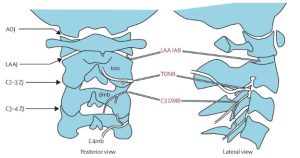
Source:
2. Manchikanti L. Facet joint pain and the role of neural blockade in its management. Curr Rev Pain. 1999;3(5):348–58.